The Milky Way Has No Billboard: Why Vietnam's Highlands Are Switching Off the Lights
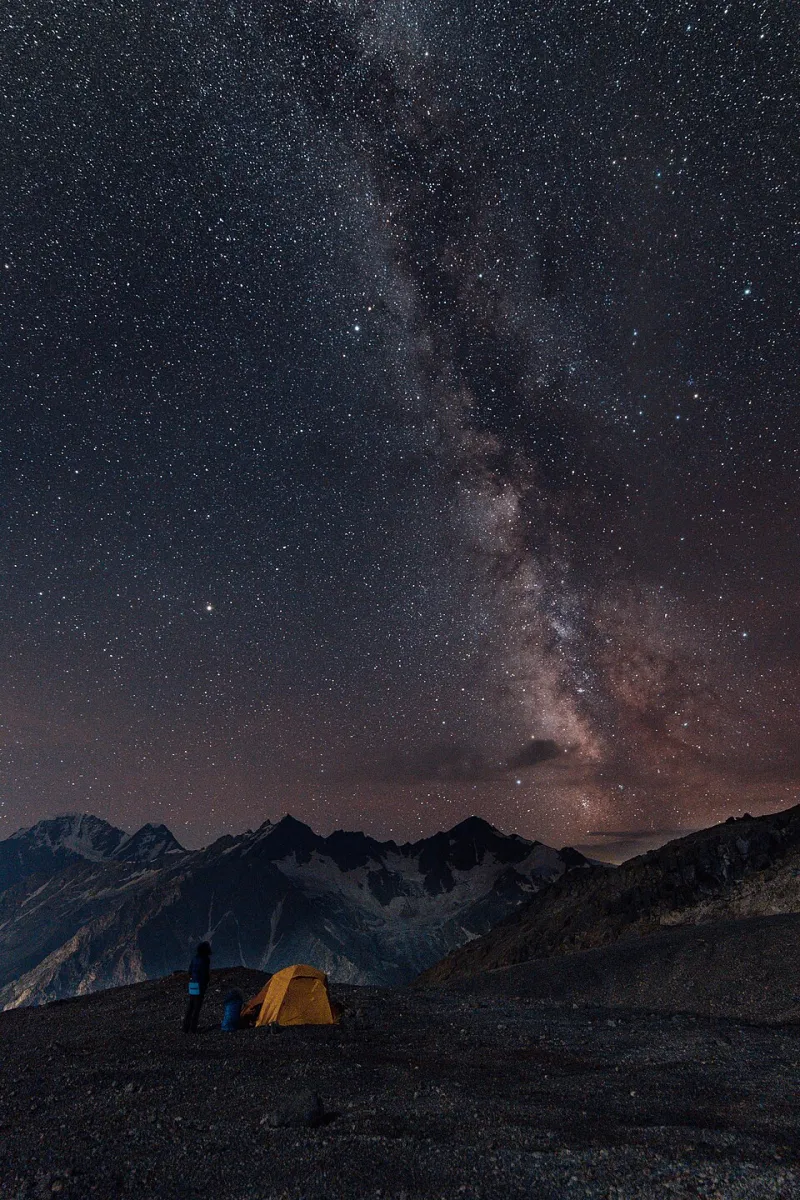
Photo: oliwok, CC BY 4.0, via Wikimedia Commons
Somewhere over the Pacific, about eleven hours into the flight from Los Angeles to Hanoi, you lose the stars. It happens gradually — the cabin lights come up, the window shade goes down, and the night sky becomes something you remember rather than something you see.
For most American travelers, that's just flying. But for a small, stubborn group of homestay owners in Vietnam's northern highlands, that moment of losing the stars is precisely the problem they're trying to solve. And they're solving it with five-dollar bulbs.
The Pollution Nobody Photographs
When we talk about sustainable travel, we talk about plastic, carbon, water, wildlife. We almost never talk about light. Yet roughly 80 percent of North Americans can't see the Milky Way from home, drowned out by the collective glow of parking lots, billboards, and the neighbor's motion-sensor floodlight. It's the only form of pollution you can undo with the flip of a switch — and one of the few you can genuinely travel away from.
Which is why the darkness over Ha Giang province matters. This is Vietnam's northernmost frontier, a buckle of limestone peaks along the Chinese border where the Dong Van Karst Plateau Geopark folds into vertical canyons and terraced cornfields. The roads are slow. The cell signal is unreliable. And critically, the towns are small enough that when the sun drops behind the ridgeline, the dark is still
dark.
For now.
Going Red in Meo Vac
On a cool evening in Meo Vac, a market town wedged against the Nho Que River gorge, I sat on the terrace of a homestay run by a Hmong family who asked me to call them by the grandmother's name, Mai. A year ago, their courtyard blazed with the cool-white LEDs that every guesthouse in Vietnam seems to buy in bulk — the kind that make a rural patio look like a gas station.
Now the terrace glows a faint amber-red. Mai's son, a former motorbike guide, switched the fixtures after a Dutch backpacker — an amateur astronomer, of all things — spent three nights photographing the sky and complained, cheerfully, that the courtyard light was ruining his exposures.
"He showed us the photos," the son told me, translating into English as he went. "The Milky Way was right over the house. I grew up here and I never really looked."
The family swapped in low-lumen warm bulbs, added red film over the pathway lights (red wavelengths don't wreck human night vision or disorient insects the way blue-white light does), and started telling guests to keep headlamps on red mode after dinner. The backpacker left a five-star review mentioning the stars specifically. Bookings followed.
There's a quiet logic here that will sound familiar to anyone who's watched dark-sky towns like Borrego Springs, California, or the certified communities around Colorado's Great Sand Dunes. Darkness, it turns out, is a marketable amenity — and unlike a pool or a spa, it costs nothing to maintain and gets better every year you leave it alone.
What the Wildlife Already Knew
The homestays aren't acting out of pure aesthetics. Vietnam's highlands run on nocturnal ecology: flying squirrels in the karst forests, moths that pollinate the very plum and peach orchards the region sells by the truckload, owls that keep the rat population around grain stores in check. Bright, unshielded, blue-heavy lighting is brutal to all of it. Insects spiral to their deaths around fixtures by the thousands. Birds migrating through the corridor between Vietnam and southern China get disoriented by skyglow.
A conservation officer with the geopark's management board put it to me bluntly: "The farmers understood the moon calendar for centuries. The LED arrived ten years ago and we forgot everything. Now we are remembering."
That's the frame American travelers should carry: this isn't about romance or Instagram. It's pest control, pollination, and predator balance, delivered by a lamp choice.
Planning a Dark-Sky Itinerary (Without Breaking the Place)
If you're building a Vietnam trip around the night sky, here's the honest guidance:
Go for the moon. Plan your highland days around the new moon. The Dong Van plateau's skies are good; they're spectacular when the moon isn't washing them out. Any moon-phase calendar app will tell you when.
Travel the slow way. The Ha Giang loop by motorbike is famous, but if that's not your speed, a hired car with a local driver gets you the same ridgelines — and keeps your money in the community rather than with a tour aggregator. Either way, build in extra days. Fog and mountain rain are part of the deal, and a rigid itinerary will fight the weather and lose.
Ask before you book. Email the homestay and ask two questions: do they use warm or red exterior lighting, and can they turn lights off after a certain hour? The question itself does work — it signals demand. Owners notice what guests ask for.
Bring red light, use it sparingly. A cheap red headlamp, and the discipline to not point it at anyone's house. And yes, put the phone away. Screens at maximum brightness in a pitch-dark village are exactly the behavior the whole project is trying to retire.
Spend on the ground. Eat at the family table, hire local guides for the geopark trails, buy the honey and the corn whiskey. If star tourism is going to fund conservation instead of construction, it has to pay the people who live under the sky, not the people who fly in to sell it.
The Question Hanging Over the Ridges
Here's the tension I can't write around: the thing that makes these skies dark is the absence of development, and tourism is development. Vietnam's coastal hotspots — Ha Long, Phu Quoc, Nha Trang — each went from fishing villages to neon skylines within a decade. Ha Giang's roads are improving. The tour groups are multiplying. Every new guesthouse is a few hundred watts brighter than the darkness it replaced.
The homestay owners I met aren't naive about this. Mai's son said something I keep turning over: "If the lights come, we want it to be our choice — small lights, warm lights, lights we can turn off. Not lights that arrive with the concrete."
Dark-sky certification, the kind the International Dark-Sky Association hands out to communities worldwide, could eventually give places like Dong Van a framework: lighting ordinances, fixture standards, a reason to say no to the floodlight. Whether the highlands get there before the resorts do is genuinely an open question.
Which means, uncomfortable as it is to say, the timing of your trip matters. The skies over the karst are still wild and star-thick, and the people beneath them are figuring out — bulb by bulb — how to keep them that way. Come quietly. Bring red light. And when you get home to a sky washed gray over your own suburb, you'll understand exactly what you were looking at.