Planting Your Way to Absolution: Inside Vietnam's Hands-On Mangrove Carbon Farms
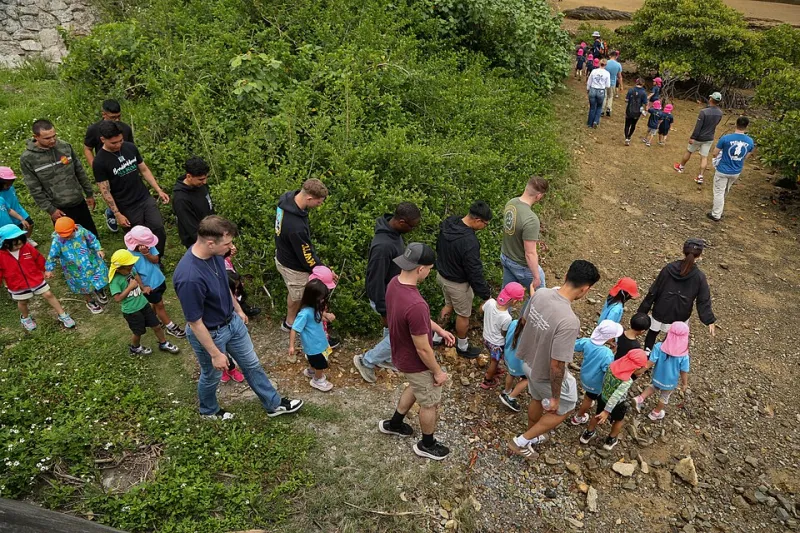
Photo: U.S. Marine Corps photo by Cpl. Jesse Davis, Public domain, via Wikimedia Commons
There's a moment, about twenty minutes into a morning of mangrove planting in Vietnam's Can Gio Biosphere Reserve, when the spreadsheet logic of carbon offsetting falls away. Your sneakers are caked in gray estuarine mud. A retired fisherman named Hung is showing you how deep to set a Rhizophora propagule — roughly to the second knuckle, angled just so — and you realize you're not purchasing absolution. You're doing manual labor.
For a growing number of US travelers, that distinction is the whole point.
The Problem With Buying Your Way Out
Americans spent millions last year on voluntary carbon offsets, and the industry's reputation has taken a beating for it. Investigations into major offset registries have found that a meaningful share of forest-based credits likely represented little real-world carbon reduction. For travelers who fly — and getting to Vietnam from the States means flying — the guilt math is brutal.
Hands-on restoration tourism offers a different proposition: instead of paying a middleman to protect trees you'll never see, you put seedlings into the mud yourself, and you can come back and check on them.
Can Gio: The Original Living Ledger
An hour and a half by speedboat from downtown Ho Chi Minh City, Can Gio's 75,000 hectares of mangrove were themselves a restoration story — replanted after wartime defoliation reduced the forest to stubble. Today, community cooperatives there run planting programs that let visitors sponsor and physically plant mangrove stands, then track their survival through the co-op's ranger teams.
The numbers are genuinely impressive. A single healthy hectare of restored mangrove can sequester several times more carbon per year than a comparable tropical terrestrial forest, thanks to the waterlogged soil that locks carbon away rather than releasing it back to the atmosphere. Mangroves also buffer storm surge — a fact not lost on Louisiana and Florida residents reading this — and serve as nurseries for the fish stocks that feed coastal communities.
"We tell visitors: don't think of this as a transaction," says one district forest ranger who has guided American volunteer groups for three seasons. "Think of it as a relationship. The trees need five years. Come back."
The Mekong Delta's Race Against the Sea
Down in Ben Tre and Ca Mau provinces, the stakes are higher still. The Mekong Delta is sinking and shrinking — hydropower dams upstream starve it of sediment while rising seas gnaw at its edges. Community mangrove nurseries here have become a kind of citizen infrastructure, with families raising seedlings in backyard ponds and selling them to restoration crews. Travelers who book through local cooperatives pay a modest fee that covers seedlings, planting labor, and five years of monitoring.
The monitoring part is what separates this from green theater. Reputable programs log GPS coordinates for every planted plot and report survival rates to participants by email. Expect honest ones: mangrove restoration projects routinely see 30–60% seedling mortality in the first two years, which is exactly why the best programs plant in waves rather than making grand one-day claims.
What US Tour Operators Are Saying
Several American ecotour companies have quietly added mangrove stops to their Vietnam itineraries in the past two years. The appeal, one California-based operator told us, is that it solves the industry's hardest problem: giving travelers something real to do about their footprint instead of just lecturing them on the flight over.
"Nobody remembers their tenth temple," she laughed. "Everybody remembers the day they planted 40 trees with a Vietnamese grandmother who out-worked them three to one."
She's careful about the framing, though. No serious operator presents a morning of planting as offsetting a 9,000-mile flight — the math doesn't work, and claiming it does is exactly the kind of overreach that sank the offset industry's credibility. The honest pitch is smaller and better: you're funding a functioning local economy, restoring habitat, and learning how carbon actually moves through a coastal ecosystem.
How to Do It Right
A few ground rules for Americans considering a mangrove stop:
- Book through the community, not a broker. Cooperatives in Can Gio and Ben Tre take direct bookings, and paying them directly keeps nearly all of your money local.
- Ask about survival rates and monitoring. If a program can't tell you what percentage of its trees are alive after three years, it's a photo op, not a project.
- Time your visit. Planting season generally runs with the rainy months; dry-season visits are better spent on monitoring walks and nursery work.
- Skip the certificate. If the program hands you a document claiming your two hours "offset" your flight, run.
Mud on Your Hands, Numbers on the Page
Is hands-on restoration tourism strictly better than buying offsets? Not necessarily — good offsets exist, and a plane full of tourists can't out-plant industrial-scale restoration crews. But the offset receipt asks nothing of you except a credit card. The mudflat asks for your morning, your attention, and your return.
As Hung told our group, wading back toward the boat: "The trees don't know the difference between a tourist and a scientist. They just need someone to come back."