Ice Cubes, Aquifers, and a Very Thirsty Island: What Your Phu Quoc Resort Isn't Telling You About Water
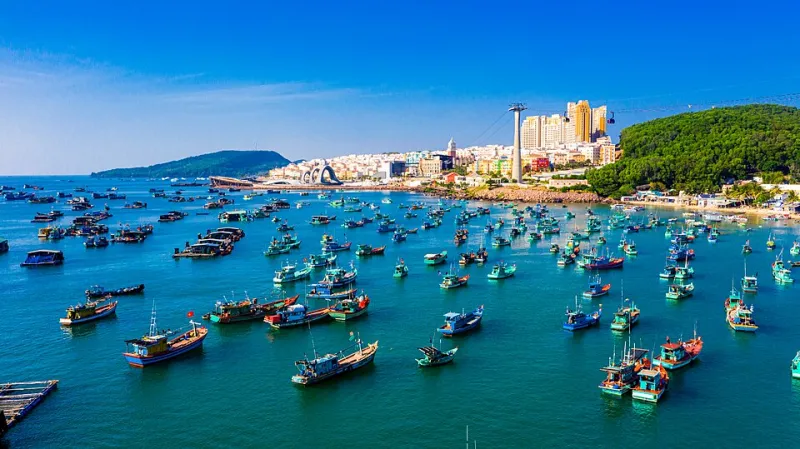
Photo: Vivu Vietnam, CC BY-SA 4.0, via Wikimedia Commons
There's a moment that happens at nearly every beach resort in Vietnam, and if you've traveled here from the States, you've probably lived it. A staff member appears at your lounger with a cooler, pulls out a chilled bottle of water with a label you don't recognize, cracks the seal in front of you, and pours it into a glass already sweating with ice.
It's a lovely ritual. It's also the most visible tip of a water problem most guests never think about — because on islands like Phu Quoc, the water in that bottle, the ice in that glass, and the shower in your villa are all drawing from the same shrinking, saltwater-invaded aquifer beneath your beach chair.
The Island Is Drinking Itself Salty
Phu Quoc sits about 10 kilometers off the Cambodian coast in the Gulf of Thailand, and until the mid-2000s it was mostly pepper farms and fishing villages. Then the Vietnamese government designated it a special economic zone, and the resort boom arrived fast — think Scottsdale or Myrtle Beach development, compressed into a decade, on an island with no river of its own.
Islands have a hydrologic quirk: the freshwater under them literally floats on top of denser seawater in a lens shape. Pump too hard, and the lens thins. Pump harder still, and salt pushes up into the wells. Hydrologists call it saline intrusion. Locals on Phu Quoc call it something more practical — the reason some wells in the Duong Dong area have been undrinkable for years.
Now layer tourism on top. A resort guest in a hot climate can easily use 300 to 500 liters of water per day — pools, laundry, long showers, and yes, that endlessly refilled ice bucket. That's several times what a local household uses. Multiply by millions of annual visitors, and you get a demand curve that no island lens can sustain.
Follow the Bottle Backward
Here's where it gets strange: the water in your room often didn't come from the island at all.
Because groundwater quality is inconsistent, many coastal resorts in Nha Trang, Da Nang, and Phu Quoc stockpile bottled water — sometimes sourced from mainland bottling plants drawing on mountain watersheds hundreds of kilometers away. Your five-liter jug may have ridden a ferry or a truck along highways you'll never see.
That means a typical American couple on a one-week beach vacation could be responsible for 60 to 100 plastic bottles, most of which won't make it into any recycling stream. Vietnam has made real progress with waste collection in tourist zones, but recycling infrastructure for PET plastic remains patchy outside the big cities. A lot of it gets burned or buried. Some of it, inevitably, ends up in the very ocean guests flew across the Pacific to admire.
And here's the irony that gets me: the bottled water is often treated as the sustainable choice — a way to avoid the tap — when the tap water crisis in coastal Vietnam is partly about over-extraction driven by tourism itself. The bottle doesn't solve the problem. It's a symptom wearing a nice label.
The Hotels Trying Something Different
The good news is that a handful of properties are quietly rethinking the whole chain, and American travelers are exactly the audience they're hoping to impress.
Atmospheric water generators. These machines pull humidity from tropical air and condense it into drinking water — essentially a high-tech dehumidifier that produces potable output. On humid Phu Quoc, where relative humidity regularly sits above 80%, they're almost embarrassingly well-suited. Several boutique resorts now run AWG units to fill glass bottles for rooms, eliminating both the aquifer draw for drinking water and the plastic supply chain. The energy cost isn't zero, but paired with rooftop solar, the math works.
Rainwater harvesting, done seriously. Vietnam gets hammered by monsoon rains — often 2,000 millimeters or more a year in central coastal provinces. That's more annual rainfall than Seattle gets, by a wide margin, and yet most of it runs off rooftops into the sea. A few eco-lodges around Phu Quoc and the Con Dao archipelago have built cistern systems capturing monsoon runoff for laundry, irrigation, and — with proper filtration — drinking water. One lodge owner told me his rainy-season tanks hold enough to run the property nearly dry-season-proof.
Sodium-free pools and greywater loops. Less glamorous, but laundry-to-garden greywater systems and native landscaping that doesn't need daily irrigation can cut a resort's freshwater draw by a third. You won't see this on the booking page, but you can ask about it.
Your Water-Responsible Stay Checklist
You don't need a hydrology degree to book smarter. Before you reserve, ask the property — or check its website — for these:
- Do they provide refill stations or in-room glass bottles instead of single-use plastic?
- Is drinking water produced on-site (AWG, filtered rainwater) or trucked in?
- Do they harvest rainwater or recycle greywater?
- Is the landscaping native or tropical-ornamental? (Ornamental lawns in the tropics mean sprinklers.)
- Do they publish any water or waste data? Even rough numbers signal seriousness.
And once you're there, small habits compound: decline the daily towel-and-linen swap, take shorter showers, and if the resort offers refillable bottles, actually use them rather than stocking up at the convenience store.
The Bigger Pour
None of this is a guilt trip. Americans traveling 8,000 miles to Vietnam should enjoy the beach, the seafood, the sunset — all of it. But water is the resource that island tourism quietly runs on, and right now the default model — pump the aquifer, bottle the rest, toss the plastic — is failing the places we love most.
The next time a staff member cracks open that bottle at your lounger, it's worth asking the front desk where the water actually came from. The answer tells you a lot about whether the resort sees the island as a home or just a backdrop. And increasingly, on Phu Quoc's quieter stretches, the best answers are falling straight out of the sky.